 Add to Chrome
 Add to Firefox
 Add to Edge
SIGMA: Semantic-Difference Instruction-Grounding Mask Annotator for Text-Driven Image Manipulation Localization
May 27, 2026
Text-driven image editing has advanced rapidly, but reliably localizing these manipulations requires image manipulation localization (IML) models trained on large pixel-annotated datasets, and there is still no low-cost way to obtain such training data at scale. We observe that these data already exist in disguise: public editing datasets contain millions of structurally identical (original, edited) pairs to IML training samples, lacking only pixel-level masks. Recovering these masks automatically is non-trivial: pixel differencing is overwhelmed by diffusion-induced perturbations across all pixels, and instruction-only grounding localizes only what the prompt describes, missing unintended editor side-effects. We propose SIGMA (Semantic-difference Instruction-Grounding Mask Annotator), which performs semantic-feature differencing in a vision foundation backbone and injects an instruction-derived spatial prior into this visual stream via bidirectional cross-modal refinement, amplifying the difference signal at intended-edit regions when the editor faithfully realizes user intent. SIGMA is trained in two complementary stages: Stage I supervises on inpainting masks; Stage II closes the diffusion-domain shift via VAE-roundtrip noise calibration, EMA self-training, and an edit-noise disentanglement loss. SIGMA outperforms existing automatic mask generators on five benchmarks (+12.20% F1, +11.16% IoU). When applied to public editing corpora, it produces a ~1.1M IML training set that improves six diverse detectors by +18.34% F1 across five datasets, turning previously unused editing data into a model-agnostic supervisory resource for IML. We'll release the full codebase as soon as the paper is accepted.

MSPT: A Lightweight Face Image Quality Assessment Method with Multi-stage Progressive Training
Aug 11, 2025
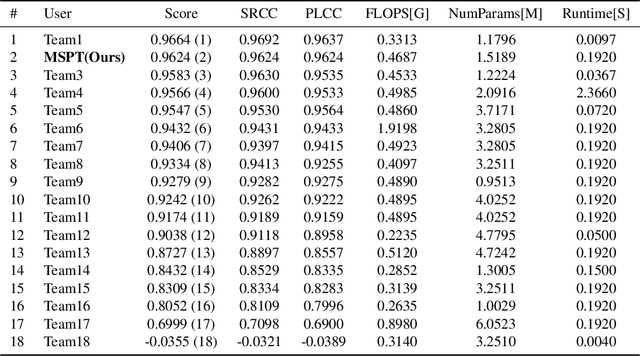
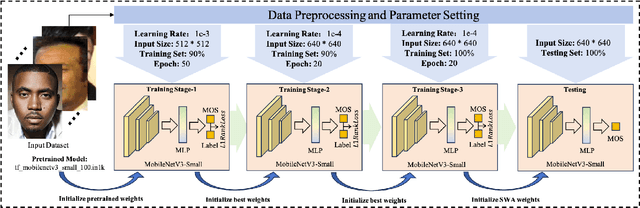

Accurately assessing the perceptual quality of face images is crucial, especially with the rapid progress in face restoration and generation. Traditional quality assessment methods often struggle with the unique characteristics of face images, limiting their generalizability. While learning-based approaches demonstrate superior performance due to their strong fitting capabilities, their high complexity typically incurs significant computational and storage costs, hindering practical deployment. To address this, we propose a lightweight face quality assessment network with Multi-Stage Progressive Training (MSPT). Our network employs a three-stage progressive training strategy that gradually introduces more diverse data samples and increases input image resolution. This novel approach enables lightweight networks to achieve high performance by effectively learning complex quality features while significantly mitigating catastrophic forgetting. Our MSPT achieved the second highest score on the VQualA 2025 face image quality assessment benchmark dataset, demonstrating that MSPT achieves comparable or better performance than state-of-the-art methods while maintaining efficient inference.